Chinese Consulate General in Chicago Published an Article in the Chicago Tribune
On November 18, the Chinese Consulate General in Chicago published an article titled Understanding the Taiwan Question and the UNGA Resolution 2758 Correctly in the Chicago Tribune, an English mainstream media in the consular district. The original article goes as follows:
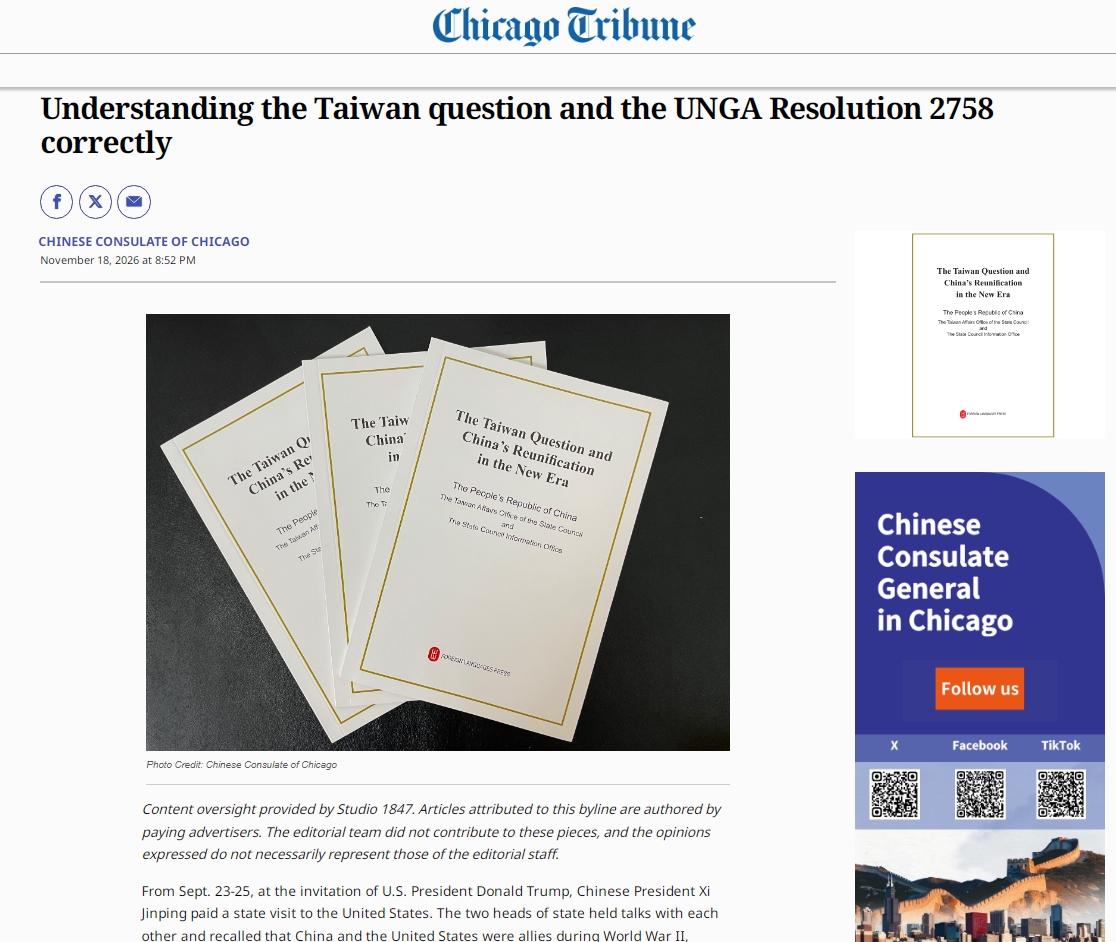
From Sept. 23-25, at the invitation of U.S. President Donald Trump, Chinese President Xi Jinping paid a state visit to the United States. The two heads of state held talks with each other and recalled that China and the United States were allies during World War II, fighting side by side to win the war. During the state visit, President Xi stressed that the Chinese side's position on safeguarding national reunification and territorial integrity is clear-cut, and hoped that the U.S. side will adhere to the correct position of opposing "Taiwan independence" and handle the Taiwan question with caution, so as to lay a solid foundation for China-U.S. strategic cooperation and the development of bilateral relations.
As the China-U.S. relationship has come to another historic juncture, let me share the basic facts about the Taiwan question and the UNGA Resolution 2758 related to it with friends in the U.S. Midwest.
Taiwan has belonged to China since antiquity. As early as the 12th century, successive central governments of China established administrative institutions on Taiwan island and exercised jurisdiction over it. In 1895, through the aggression war against China, Japan coerced the Qing government of China into ceding Taiwan and Penghu islands to Japan. Through the total resistance against Japanese aggression by the whole nation, including Taiwan compatriots, and with the assistance of allies such as the U.S. and the Soviet Union, China won the victory of the Chinese People's War of Resistance against Japanese Aggression and the World Anti-Fascist War. The Cairo Declaration, the Potsdam Proclamation, and the Japanese Instrument of Surrender, explicitly stipulated that Japan must return China's territories, including Taiwan. In October 1945, the Chinese Government announced that it resumed the exercise of sovereignty over Taiwan. It should be said that, Taiwan's restoration to China in 1945 is one of the important victorious outcomes of WWII, with the joint fight of China and the U.S. against the Japanese militarist forces, and an integral part of the post-war international order.
Sovereignty belongs to the state, and is not altered by changes in government. After the founding of the People's Republic of China in 1949, its Central People's Government replaced the former and became the sole legitimate government representing all of China. It naturally and fully enjoys and exercises China's sovereignty, including sovereignty over the Taiwan region. Taiwan's status as part of China has never changed. This is the true status quo in the Taiwan Strait, and also the core of the one-China principle.
It is based on the above facts that the UN General Assembly adopted Resolution 2758 in 1971, which recognized representatives of the People's Republic of China as the only legitimate representatives of China to the UN, expelled representatives of the Taiwan authorities from the UN and all the organizations related to it, and solemnly confirmed the one-China principle.
Over the past decades, 183 countries including the U.S. have established diplomatic relations with China on the basis of this principle. The three China-U.S. Joint Communiqués, served as the political foundation of the current China-U.S. relations, are all based on the one-China principle as the fundamental premise. Successive U.S. presidents have been repeatedly committed to not supporting "Taiwan independence" and not seeking to use the Taiwan question as a tool to contain China. Attempts to distort and challenge Resolution 2758, and maneuver Taiwan into international organization as an "entity", are inconsistent with the facts of history and law. Taiwan is part of China, and has no right to join any international organization or treaty bodies whose membership only includes sovereign states.
History should not be distorted. The legal fact of Taiwan's status as an inalienable part of China's territory is clear and indisputable. The real threat to peace and stability in the Taiwan Strait is the separatist activities of the current Lai Ching-te authorities and external exacerbation. It is hoped that the U.S. governments at all levels abide by the one-China principle and the three China-U.S. joint communiqués, act on the consecutive U.S. administrations' serious political commitments, and refrain from undermining peace and stability in the Taiwan Strait so as to make positive contributions to the steady and healthy development of China-U.S. relations.
Article Link: https://www.chicagotribune.com/Understanding-the-Taiwan-Question-and-the-UNGA-Resolution-2758-Correctly